
 If your new car keeps breaking down and the dealer can’t fix it, you have two real options for fighting back — and they lead to very different outcomes.
Choose state arbitration if you want a fast, free, low-stress resolution and you’re comfortable accepting a possibly smaller remedy; choose a lemon law lawsuit if you want the largest recovery, leverage against the manufacturer, and an attorney whose fees the carmaker pays if you win. For most San Diego drivers with a clearly defective vehicle and good repair records, a lemon law lawsuit produces a stronger result, because California’s fee-shifting rules mean you typically pay nothing out of pocket and may recover a civil penalty on top of a buyback. Arbitration shines when the dispute is simpler, you value speed over maximum payout, or you want to preserve the option to sue later.
Understanding State Arbitration
State arbitration is an out-of-court dispute-resolution process where a neutral third party — the arbitrator — reviews your complaint about a defective vehicle and the manufacturer’s response, then issues a decision. In California, many automakers run or participate in arbitration programs that the state Department of Consumer Affairs has certified, which adds a layer of oversight to how disputes are heard.
How it works. You file a claim, submit your documentation (purchase contract, repair orders, and a log of how many times the car has been in the shop), and the manufacturer responds. Depending on the program, your case is decided through a document review, a phone hearing, or an in-person hearing. The arbitrator can order a repurchase, a replacement, additional repairs, or reimbursement. A key feature in California: the decision is generally binding on the manufacturer if you accept it, but you are usually not bound — if you reject the outcome, you can still pursue a lawsuit.
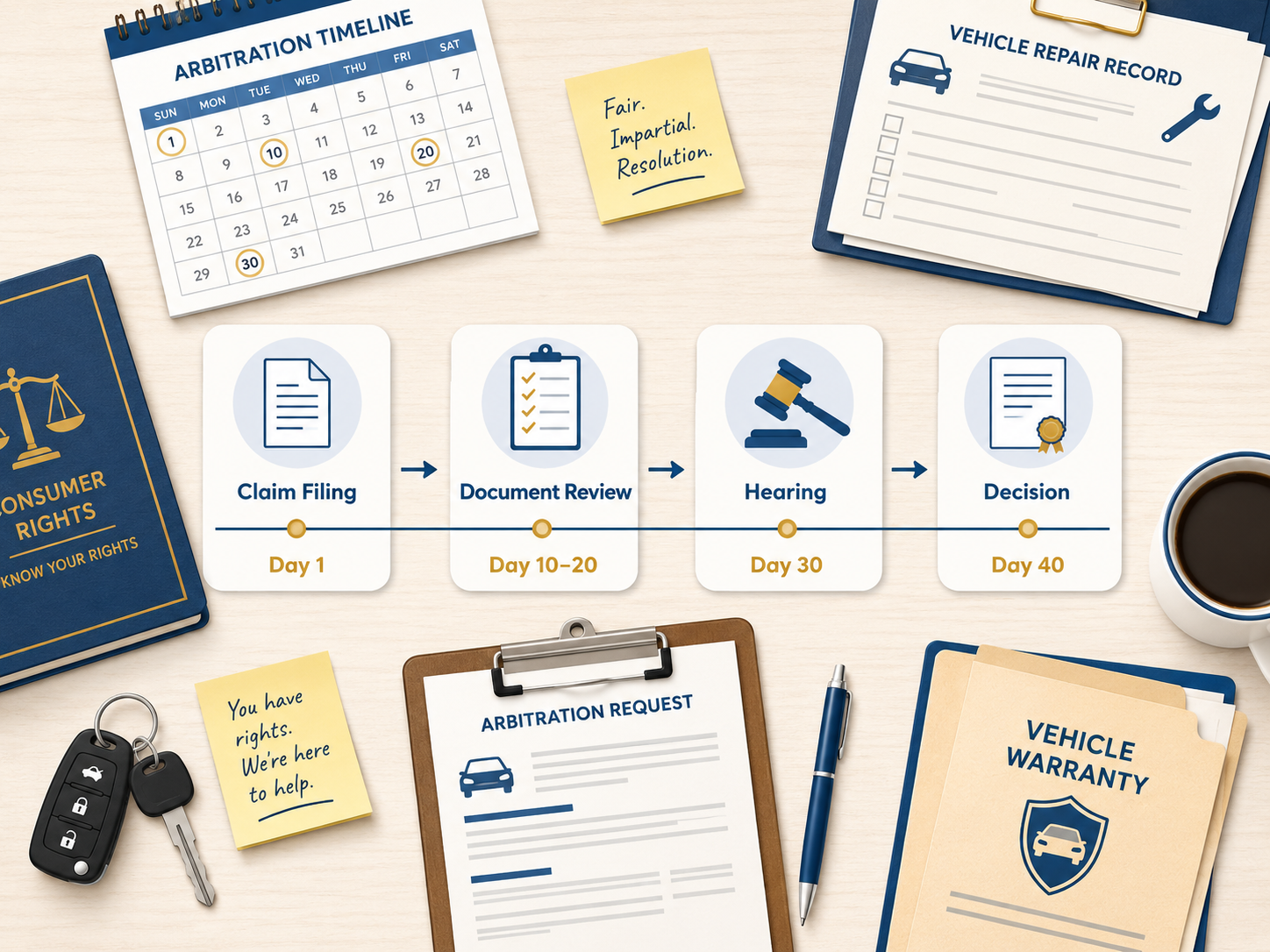 Typical costs. Arbitration is normally free to the consumer. There are no filing fees and no attorney is required, although you’re allowed to bring one.
Core benefits. Speed and simplicity. Many programs resolve cases in roughly 40 to 60 days, far faster than litigation. It’s informal, low-pressure, and a reasonable first step if your case is straightforward.
Ideal use cases. A relatively clean-cut defect, strong paperwork, a desire to avoid a drawn-out fight, or a situation where you want a quick read on how a neutral party views your claim before deciding whether to escalate.
Understanding a Lemon Law Lawsuit
A lemon law lawsuit is a civil case filed under California’s Song-Beverly Consumer Warranty Act — the statute most people mean when they say “the lemon law.” Instead of a manufacturer-affiliated program, your case enters the court system, often through San Diego Superior Court, with an attorney advocating for you.
How it works. Your attorney files suit against the manufacturer, then uses the formal discovery process to demand internal records — technical service bulletins, repair histories, and warranty data the manufacturer would never volunteer in arbitration. That evidence is what gives litigation its leverage. The large majority of these cases settle before trial once the manufacturer sees the documentation stacked against it.
 Typical costs. This is where California law tilts the field toward consumers. The lemon law contains a fee-shifting provision: when you win, the manufacturer pays your reasonable attorney fees and costs. That’s why most lemon law attorneys take qualifying cases on contingency, so you generally pay nothing out of pocket. (Confirm exact fee-recovery mechanics with counsel before relying on this.)
Core benefits. Bigger recoveries. A successful lawsuit can deliver a full buyback — your purchase price refunded, minus a mileage offset for use before the trouble started — plus, in cases of willful violation, a civil penalty of up to two times your actual damages. The discovery leverage and the credible threat of trial routinely produce stronger settlements than arbitration.
Ideal use cases. Substantial damages at stake, multiple failed repair attempts, a safety defect, a manufacturer that has been stonewalling, or any situation where you want maximum compensation and professional representation.
Side-by-Side Comparison
| Attribute | State Arbitration | Lemon Law Lawsuit |
|---|---|---|
| Upfront Cost | Free; no attorney required | Typically $0 out of pocket via fee-shifting/contingency |
| Typical Timeline | ~40–60 days | Several months to a year+ (most settle) |
| Evidence Access | Limited to what you submit | Full discovery of manufacturer’s internal records |
| Potential Recovery | Repair, replacement, or repurchase | Buyback or replacement plus possible 2x civil penalty |
| Formality / Effort | Low; informal hearing or paperwork | Higher; attorney-managed litigation |
| Binding on You? | No — you can reject and sue | Settlement/judgment is final once accepted |
| Best For | Speed, simplicity, smaller disputes | Maximum payout, leverage, complex cases |
Pros and Cons Breakdown
Pros of State Arbitration
- It’s free. No filing fees and no lawyer required, so there’s almost no financial barrier to entry.
- It’s fast. A resolution in weeks rather than months keeps you from waiting endlessly while your car sits unreliable.
- It’s low-pressure. The informal format is far less intimidating than a courtroom for a first-time claimant.
- You keep your options open. Because the decision usually isn’t binding on you, a rejected outcome doesn’t slam the door on a lawsuit.
Cons of State Arbitration
- Smaller remedies. Arbitrators frequently order more repairs rather than a full buyback, and civil penalties are generally off the table.
- Information imbalance. Without discovery, you can’t compel the manufacturer to hand over the internal records that often prove a defect.
- The home-field dynamic. Programs affiliated with manufacturers can feel tilted, which is why many advocates urge caution before relying on arbitration alone.
- Time spent first. If you arbitrate, lose, and then sue, you’ve added weeks to an already long road.
Pros of a Lemon Law Lawsuit
- The manufacturer pays your attorney. California’s fee-shifting rule is the single biggest reason litigation is accessible to ordinary San Diego drivers.
- Bigger potential payout. Full repurchase plus a possible civil penalty can far exceed what arbitration awards.
- Real leverage. Discovery and the threat of trial pressure manufacturers into serious settlements.
- Professional representation. An experienced attorney handles deadlines, paperwork, and negotiation so you don’t have to.
Cons of a Lemon Law Lawsuit
- It takes longer. Even cases that settle can run several months; a few stretch past a year.
- More involvement. You’ll need to provide documents and stay engaged, though your attorney carries the load.
- Outcome isn’t guaranteed. As with any legal claim, success depends on the strength of your evidence and repair history.
Which Option Is Better? The Ultimate Showdown
The honest answer is that it depends on what you value most — but the math tends to favor litigation for serious cases.
Run the cost-versus-benefit comparison. Arbitration’s appeal is its zero cost and quick turnaround. But “free and fast” only wins if the result is adequate. If an arbitrator orders another repair on a car that’s already failed three times, you’ve spent your speed advantage on an outcome that doesn’t solve the problem. A lawsuit takes longer, yet because the manufacturer pays your attorney fees when you prevail, your effective cost is often comparable to arbitration — near zero — while the potential recovery is meaningfully larger.
Choose state arbitration if your priority is a quick, no-cost resolution, your defect is straightforward, your paperwork is airtight, and you’d be satisfied with a modest remedy. It’s also a sensible move when you specifically want to preserve the right to sue later, since a rejected decision generally doesn’t bar litigation.
Go with a lemon law lawsuit if your priority is maximum compensation, you’ve endured multiple failed repairs, your vehicle has a safety-related defect, or the manufacturer has been unresponsive. For most San Diego drivers who depend on their car for long commutes from Chula Vista, El Cajon, or North County — where there’s no shrugging off an unreliable vehicle — the leverage and payout of litigation make it the stronger choice. San Diego’s mix of coastal humidity and inland desert heat can also accelerate certain mechanical and electrical failures, and a lawsuit’s discovery process is far better suited to proving a pattern of defects.
The practical play many drivers use: treat arbitration as a low-risk first look, and keep a lemon law attorney’s number handy so you can escalate the moment the outcome falls short.
Talk to a San Diego Lemon Law Team
You don’t have to map this decision out alone. If your vehicle keeps failing despite repeated repair attempts, the smartest first step is understanding which path fits your facts — and that starts with knowing how many repair attempts the law typically requires and what your legal options look like after failed repairs.
A consultation is a low-pressure way to learn where you stand. Whether you’re driving a leased commuter car through Mission Valley or a weekend RV up the coast, a San Diego attorney can tell you in one conversation whether arbitration or litigation gives you the better shot. Schedule a free California lemon law consultation to get a clear, honest read on your case — no obligation to file.
Already gathering paperwork? Start by learning how to document defects for a lemon law claim so your records are ready whichever route you choose.
Conclusion & Recommendation
State arbitration and a lemon law lawsuit both exist to get a defective vehicle off your hands — but they serve different drivers. Arbitration is the fast, free, lower-reward option that’s worth considering for simple cases and as a first move that keeps litigation on the table. A lemon law lawsuit is the higher-leverage path that, thanks to California’s fee-shifting rules, often costs you nothing out of pocket while delivering the largest recoveries, including a potential civil penalty.
For the majority of San Diego drivers facing a genuinely defective vehicle and a manufacturer reluctant to make it right, a lemon law lawsuit is the recommended path — it pairs strong leverage with little financial downside. When in doubt, a free consultation will settle which option fits your situation best.
Frequently Asked Questions
1. Is state arbitration required before I can file a lemon law lawsuit in California?
Not always. California may require you to use a manufacturer’s qualified dispute-resolution program before invoking certain lemon law presumptions, but it is generally not an absolute bar to suing. The specifics depend on the manufacturer’s program and current law, so confirm with an attorney for your exact situation.
2. Does arbitration cost anything?
For consumers, state-certified arbitration is typically free — no filing fees, and no attorney is required. You can choose to bring an attorney, but you don’t have to.
3. Will I have to pay a lawyer out of pocket for a lemon law lawsuit?
Usually not. California’s lemon law includes a fee-shifting provision, so when you win, the manufacturer pays your reasonable attorney fees. That’s why most lemon law attorneys handle qualifying cases on contingency.
4. Which option pays more?
A lawsuit generally has the higher ceiling. It can produce a full buyback plus, in cases of willful violation, a civil penalty of up to two times your actual damages — remedies arbitration rarely matches.
5. How long does each option take?
Arbitration often resolves in roughly 40 to 60 days. A lawsuit usually takes several months, though many settle well before trial.
6. Can I reject an arbitration decision and still sue?
In most California cases, yes. The decision is typically binding on the manufacturer if you accept it, but you usually aren’t bound and can pursue litigation if you reject the outcome.
7. What evidence matters most for either path?
Your repair orders, the number of repair attempts, your purchase or lease contract, and a clear timeline of the defect. Thorough documentation strengthens your position in both arbitration and a lawsuit.
8. Does it matter that I’m in San Diego specifically?
Your rights come from California’s statewide lemon law, but a local San Diego attorney knows the regional courts and can meet with you in person. Local climate and heavy commuting can also affect how defects develop and how they’re proven.
9. What if my lemon law claim gets denied?
A denial isn’t the end of the road. Depending on the path you took, you may be able to escalate, gather stronger evidence, or pursue litigation. An attorney can explain your remaining options.
10. Does this apply to leased vehicles, used cars, motorcycles, and RVs?
California’s lemon law can cover a range of vehicle types, with specifics varying by category. Confirm eligibility for your particular leased car, used vehicle, motorcycle, or RV with a qualified attorney.
Lawyer Associations


Scott Law Group P.C. May be Able to Help
At our top rated firm, we have over a decade of prior law experience defending Fortune 500 companies in these types of complex cases. Every case is unique and we fight arduously to find a solution to every case and have the courts decide in our clients’ favor. We use our extensive professional experience to find the best positive outcome possible for our valued clients. Some lemon law firms will hand over the case to another law firm if the manufacturer wants to go to trial. But Christian is aggressive and willing to litigate in order to get a favorable result for his valued clients. Whether you bought or leased a new or used motor vehicle such as a car, truck, motorcycle, SUV or RVs/motor home, let us give you our expert advise. You may have numerous frequently asked questions prior to deciding to pursue a case. Rather than have you try to figure it out for yourself, let us advise you and let’s talk it through. We’ll address any concern and answer any question you may have prior to making any decisions on pursuing a case. We provide statewide service in California.
Rather than try to take on the vehicle manufacturer yourself, call the best lemon law lawyer in San Diego and let Christian Scott, the best attorney in your area give you the professional advice you need regarding a possible case. We provide statewide service and we offer the best customer service around. Do not hesitate any longer, call now for a FREE case review. All calls are returned within 24 hours. Or if you prefer, complete the FREE Case Review Form. Remember, you have nothing to lose, it’s FREE!
Litigation Lemon Law Group
SCOTT LAW GROUP P.C. represents plaintiffs detailed in the areas served section and across California who have purchased a lemon vehicle, have been seriously injured in an accident or have been a victim of dealer fraud. Examples of dealer fraud include undisclosed repairs or accident damage, undisclosed rental use and changing the terms after the purchase has been negotiated and the car is taken home. If you received a Notice of Intent after your vehicle was repossessed or if you purchased a prior lemon vehicle, we want to hear from you. We have also provided a lemon law news section where you can reference information regarding this issue. We have over a decade of prior experience defending Fortune 500 companies in these types of cases. We know what corporate America thinks, does and hides and we use that experience to sue auto manufacturers, dealerships, businesses and individuals on behalf of our valued clients to recover damages and rightly compensate them for their losses. We provide excellent legal representation in both English and Spanish (Español). We can evaluate your case via our online Free Case Review form. We are serious. We achieve amazing results for our valued clients. This is who we are. This is what we do and we do it well.
