
 When a defective vehicle finally qualifies under California’s lemon law, most San Diego drivers face one practical decision: take the manufacturer’s full buyback (give the car back, get your money back) or accept a cash settlement and keep driving it. Choose a buyback when the defect is serious, ongoing, or safety-related and you want out of the vehicle entirely; choose a cash settlement when the issue is largely resolved, you still like the car, or high mileage would shrink a buyback’s payout. A buyback returns most or all of what you paid but brands the title and takes the car. A cash settlement is faster and keeps your title clean, but pays far less. The right answer depends on the defect, the mileage, and your plans for the vehicle.
Understanding the Lemon Law Buyback
A lemon law buyback (also called a repurchase) is the headline remedy under California’s Song-Beverly Consumer Warranty Act, codified at Civil Code § 1793.2(d)(2). When a manufacturer can’t fix a substantial defect after a reasonable number of repair attempts, it must repurchase the vehicle and make you financially whole.
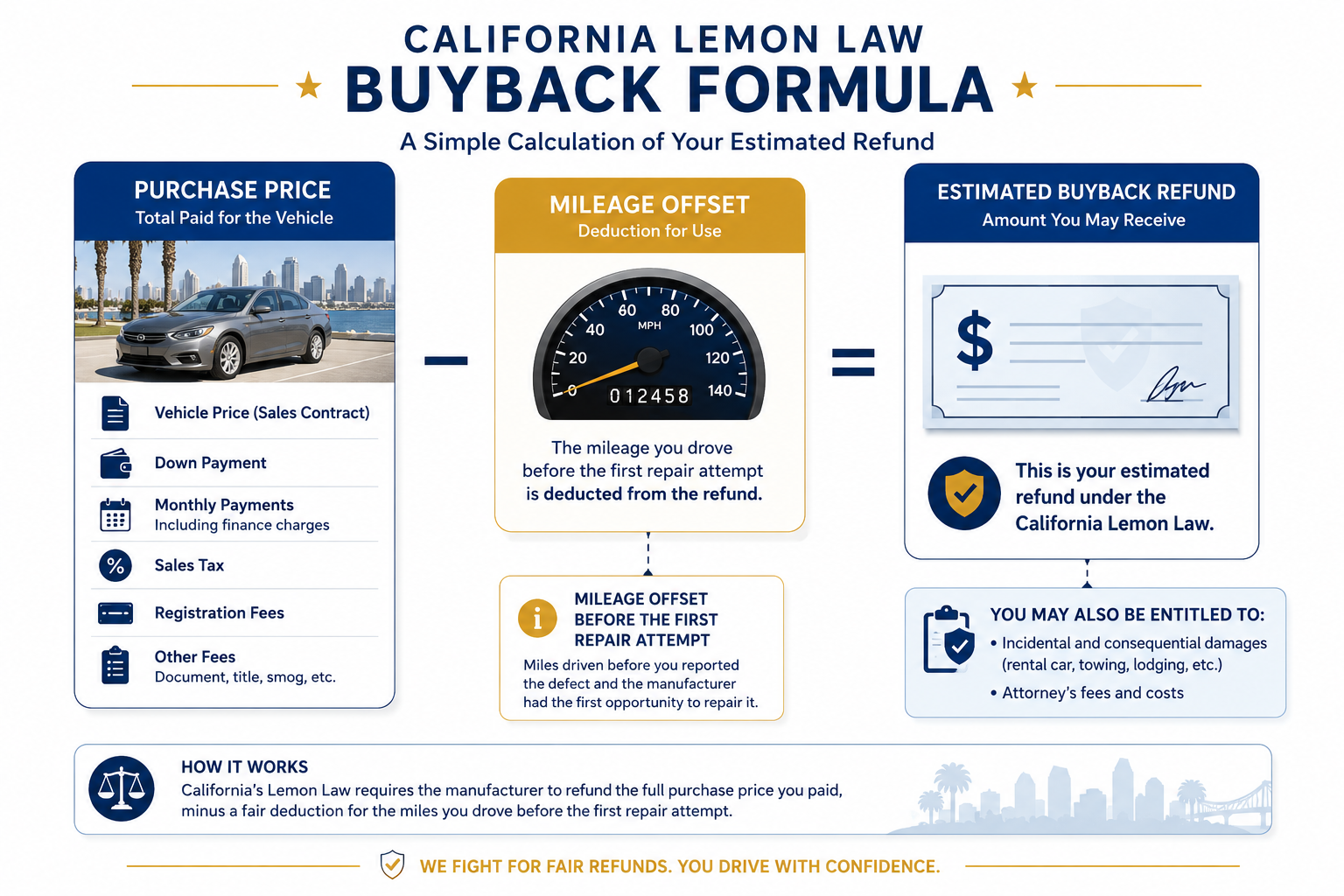
How it works: You surrender the car, and the manufacturer refunds the money you put into it. That refund typically includes your down payment, every monthly payment made, the remaining loan payoff, sales and use tax, registration and license fees, finance charges you paid, and incidental or consequential costs the defect caused, such as towing, rental cars, or rideshare during repeated shop visits, an everyday expense for commuters white-knuckling the I-5 and I-15 to and from San Diego’s job centers.
The one deduction, “the mileage offset”: The manufacturer is allowed to subtract a usage fee for the miles you drove before the first repair attempt for the qualifying defect. The statutory formula is:
(Miles at first repair attempt ÷ 120,000) × Purchase Price = Mileage Offset
California treats 120,000 miles as a vehicle’s expected lifespan. Because the offset is tied to the first repair date, strong documentation of when you first reported the problem is the single most effective way to keep that deduction small.
Typical “cost”: A buyback generally costs you nothing out of pocket. Under § 1794(d), the manufacturer pays your attorney’s fees separately, so your settlement isn’t eaten up by legal bills. The real trade-offs are non-financial: you lose the car, you wait several weeks for paperwork and payment, and the vehicle’s title is permanently branded “Lemon Law Buyback” before it can be resold to anyone else.
Ideal use case: Serious, recurring, or safety-related defects, vehicles still in the lower-mileage range, and drivers who simply want to be done with the car. If a known model-wide pattern is involved, a buyback gets you out before the problem returns.
Understanding the Cash Settlement
A cash settlement, commonly called a “cash and keep,” is the third primary outcome alongside buyback and replacement. Instead of returning the car, you accept a lump-sum payment and keep driving it.
How it works: The manufacturer writes you a check to compensate for the defect, the diminished value, and the inconvenience you endured. In exchange, you keep the vehicle and release the manufacturer from a buyback claim for that specific issue. Unlike the buyback, there is no statutory formula, the number is purely negotiated.
Typical cost and payout: Cash-and-keep amounts commonly land in the range of roughly 10–30% of the vehicle’s purchase price, though that varies heavily by defect severity, repair history, and the strength of your underlying claim. As with a buyback, attorney’s fees under § 1794(d) are generally paid by the manufacturer separately, so your net recovery is the full settlement amount. Manufacturers often favor this route because it’s cheaper and faster for them, which is precisely why drivers should run the numbers before accepting a first offer.
Two big advantages: First, no title brand, in a cash settlement the vehicle keeps a clean title, which matters a great deal for resale value. Second, no mileage offset, since you aren’t being “refunded,” the usage deduction that can gut a buyback on a high-mileage car simply doesn’t apply.
The catch: The payment is usually smaller than a buyback, the defect stays with you, and once you accept, you generally cannot pursue additional lemon law remedies for that same defect later.
Ideal use case: The defect is minor or has been (mostly) resolved, you genuinely like the car and want to keep it, the mileage is high enough that a buyback’s offset would erode the refund, or you’d simply rather have flexibility and cash than surrender the vehicle.
Side-by-Side Comparison
| Attribute | Lemon Law Buyback | Cash Settlement (Cash & Keep) |
|---|---|---|
| Do you keep the car? | No, manufacturer takes ownership | Yes, you keep driving it |
| Typical payout | Most or all of what you paid, minus mileage offset | Negotiated lump sum, often ~10–30% of purchase price |
| Mileage offset applied? | Yes, reduces refund based on miles at first repair | No, the offset doesn’t apply |
| Title impact | Branded “Lemon Law Buyback” (on the surrendered car) | Title stays clean |
| Speed to resolve | Slower, several weeks for paperwork and payment | Generally faster |
| Future claims for that defect | N/A, you no longer own the car | Usually waived once accepted |
| Attorney’s fees | Paid separately by manufacturer (§ 1794(d)) | Paid separately by manufacturer (§ 1794(d)) |
| Best for | Serious/ongoing defects, lower mileage, want out | Minor/resolved defects, high mileage, want to keep car |
Pros and Cons Breakdown
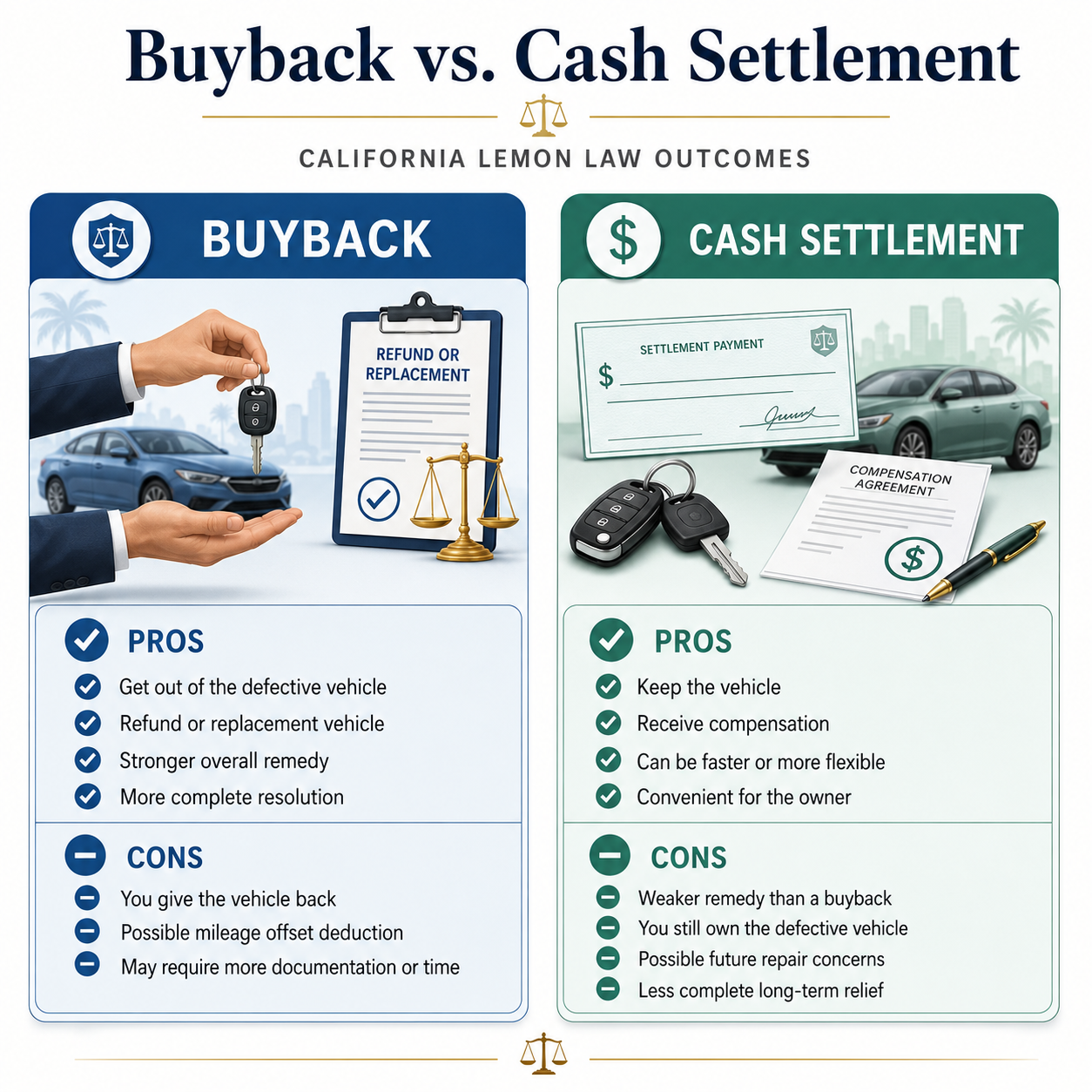
Pros of the Buyback
- Maximum recovery: You get back most or all of your down payment, monthly payments, taxes, and fees, the most complete financial reset available.
- You’re free of the defective car: No lingering risk that the problem returns on the 8 or the 805.
- Incidental costs covered: Towing, rentals, and rideshare tied to the defect can be reimbursed.
- Clean break for safety defects: The strongest option when the issue affects safe operation.
Cons of the Buyback
- Mileage offset reduces the refund: The more you drove before the first repair, the bigger the deduction.
- You lose the car: If you actually like the vehicle, that’s a real cost.
- Slower process: Expect several weeks for paperwork and payment to clear.
- Title branding: The car you surrender carries a permanent lemon brand (this affects the manufacturer’s resale, not you, but it underscores the severity).
Pros of the Cash Settlement
- Keep your car: Ideal if the defect is resolved and you’re attached to the vehicle.
- Clean title preserved: No lemon brand, so resale value isn’t dented by the law.
- No mileage offset: A major advantage on high-mileage vehicles.
- Faster and more flexible: Quicker cash, and you decide how to use it.
Cons of the Cash Settlement
- Smaller payout: Typically a fraction of a full buyback.
- You keep the defect: If it returns or worsens, that’s now your problem.
- Waiver of future claims: Accepting usually ends your lemon rights for that defect.
- Favors the manufacturer: First offers are often lowball, designed to close cheaply.
Which Option Is Better? The Ultimate Showdown
There’s no universal winner, only the right fit for your situation, so here’s how to decide.
Choose the buyback if your priority is getting fully reimbursed and getting out. When the defect is safety-related, recurring, or part of a known model-wide pattern, the buyback is almost always the stronger move. On a relatively low-mileage vehicle, the mileage offset stays small and your refund stays close to whole. For a San Diego commuter who can’t afford to be stranded mid-trip on the I-805 during rush hour, removing the unreliable car from the equation has value that a modest cash check can’t match.
Choose the cash settlement if your priority is keeping a car you still like, or preserving value on a high-mileage vehicle. Here’s the math that surprises people: on a high-mileage car, the buyback’s mileage offset can shrink the refund so much that a clean-title cash settlement nets out comparably, while letting you keep the vehicle. Add San Diego’s brutal resale dynamics, where a clean title commands a real premium, and a settlement that avoids the lemon brand can be the smarter financial play when the defect is genuinely resolved.
The decisive factors: (1) Defect severity and whether it’s ongoing, (2) your mileage at the first repair attempt, (3) whether you want to keep the car, and (4) the gap between the manufacturer’s offer and what a buyback would actually yield. Because manufacturers profit when you accept a quick cash offer, the worst outcome is taking a lowball settlement on a vehicle that genuinely qualified for a full buyback. Run both numbers before you sign anything.
A 2025–2026 note San Diego drivers should know
California’s lemon law went through a procedural overhaul. AB 1755 (2024), cleaned up by SB 26 in April 2025, created an optional framework manufacturers can opt into for five years. Under the opted-in track, there’s a mandatory 30-day pre-suit written notice, mandatory mediation before a lawsuit, and a shorter window to file. Critically, you generally must keep possession of the vehicle while the claim is pending, roughly 30 days after your demand and 60 days after any offer, which matters for lessees near the end of a lease. If a manufacturer hasn’t opted in, the traditional Song-Beverly protections and the same buyback formula still apply.
Internal Resources by Vehicle Type
The buyback-versus-settlement calculus shifts depending on what you drive. If you have questions specific to your vehicle, these pages go deeper:
- Leased Vehicles – where possession-during-claim rules hit hardest
- Used Vehicles -still under the original or CPO warranty
- Motorcycle Lemon Law – for two-wheeled defects
- RV and Motorhome Lemon Law – where high purchase prices change the math
Talk to a San Diego Lemon Law Team
You don’t have to decide between a buyback and a cash settlement alone, and you shouldn’t accept a manufacturer’s first number without checking it. If you’re a San Diego driver weighing your options, a free, no-pressure consultation can tell you what a full buyback would actually pay versus the settlement on the table, so you choose from a position of knowledge rather than guesswork. Because attorney’s fees are paid by the manufacturer under § 1794(d), getting that clarity typically costs you nothing.
Conclusion & Recommendation
For most serious, ongoing, or safety-related defects, especially on lower-mileage vehicles, the buyback is the stronger remedy: it returns the most money and removes the problem car entirely. The cash settlement wins when the defect is minor or resolved, you want to keep the car, or high mileage would gut a buyback’s refund and a clean title is worth preserving. The smartest move is to calculate both outcomes for your specific vehicle before signing, and lean on professional guidance so a quick cash offer doesn’t cost you a fuller recovery you were entitled to.
Frequently Asked Questions
1. Is a lemon law buyback better than a cash settlement in California?
It depends on your situation. A buyback usually pays more and removes the defective car, making it the stronger choice for serious or ongoing defects on lower-mileage vehicles. A cash settlement is better when the defect is resolved, you want to keep the car, or high mileage would significantly reduce a buyback’s refund.
2. How much is a typical cash-and-keep settlement worth?
There’s no statutory formula, the amount is negotiated. Cash settlements commonly fall in the range of roughly 10–30% of the vehicle’s purchase price, depending on the defect’s severity, the repair history, and the strength of your claim.
3. Does a cash settlement put a lemon brand on my title?
No. The “Lemon Law Buyback” title brand applies only when the manufacturer repurchases the vehicle. In a cash-and-keep settlement, you keep the car and the title generally stays clean, which helps preserve resale value.
4. Can I still sue if I accept a cash and keep settlement?
Generally no. Once you accept a cash settlement, you typically waive the right to pursue additional lemon law remedies for that same defect. That’s why it’s important to confirm the offer is fair before signing.
5. How is the buyback mileage offset calculated?
California uses the formula (miles at the first repair attempt ÷ 120,000) × purchase price. The 120,000 figure represents a vehicle’s expected lifespan under state law. Documenting when you first reported the defect helps keep this deduction as low as possible.
6. How long does a lemon law buyback take?
Once a claim is approved, the buyback itself can take several weeks while paperwork is processed and payment clears. A cash settlement is generally faster. Overall timelines vary based on the manufacturer, documentation, and whether the claim is contested.
7. Do I pay attorney’s fees out of my settlement?
Typically no. Under California Civil Code § 1794(d), the manufacturer is responsible for the consumer’s attorney’s fees separately, so your buyback refund or cash settlement is generally not reduced to cover legal costs.
8. Does the buyback include my down payment, taxes, and fees?
Yes. A proper buyback reimburses your down payment, monthly payments, loan payoff, sales and use tax, registration and license fees, finance charges, and certain incidental costs, minus only the statutory mileage offset.
9. What changed about California’s lemon law in 2025?
AB 1755 (2024), refined by SB 26 in April 2025, introduced an optional framework manufacturers can opt into. Opted-in claims involve a 30-day pre-suit notice, mandatory mediation, a shorter filing window, and a requirement to keep possession of the vehicle during the claim. Traditional Song-Beverly protections still apply to manufacturers that haven’t opted in.
10. Should I accept the manufacturer’s first cash offer?
Not without checking it. Manufacturers benefit when you accept a quick, low cash offer, so the biggest risk is settling cheap on a car that qualified for a fuller buyback. Compare both outcomes, ideally with professional guidance, before agreeing to anything.
Lawyer Associations


Scott Law Group P.C. May be Able to Help
At our top rated firm, we have over a decade of prior law experience defending Fortune 500 companies in these types of complex cases. Every case is unique and we fight arduously to find a solution to every case and have the courts decide in our clients’ favor. We use our extensive professional experience to find the best positive outcome possible for our valued clients. Some lemon law firms will hand over the case to another law firm if the manufacturer wants to go to trial. But Christian is aggressive and willing to litigate in order to get a favorable result for his valued clients. Whether you bought or leased a new or used motor vehicle such as a car, truck, motorcycle, SUV or RVs/motor home, let us give you our expert advise. You may have numerous frequently asked questions prior to deciding to pursue a case. Rather than have you try to figure it out for yourself, let us advise you and let’s talk it through. We’ll address any concern and answer any question you may have prior to making any decisions on pursuing a case. We provide statewide service in California.
Rather than try to take on the vehicle manufacturer yourself, call the best lemon law lawyer in San Diego and let Christian Scott, the best attorney in your area give you the professional advice you need regarding a possible case. We provide statewide service and we offer the best customer service around. Do not hesitate any longer, call now for a FREE case review. All calls are returned within 24 hours. Or if you prefer, complete the FREE Case Review Form. Remember, you have nothing to lose, it’s FREE!
Litigation Lemon Law Group
SCOTT LAW GROUP P.C. represents plaintiffs detailed in the areas served section and across California who have purchased a lemon vehicle, have been seriously injured in an accident or have been a victim of dealer fraud. Examples of dealer fraud include undisclosed repairs or accident damage, undisclosed rental use and changing the terms after the purchase has been negotiated and the car is taken home. If you received a Notice of Intent after your vehicle was repossessed or if you purchased a prior lemon vehicle, we want to hear from you. We have also provided a lemon law news section where you can reference information regarding this issue. We have over a decade of prior experience defending Fortune 500 companies in these types of cases. We know what corporate America thinks, does and hides and we use that experience to sue auto manufacturers, dealerships, businesses and individuals on behalf of our valued clients to recover damages and rightly compensate them for their losses. We provide excellent legal representation in both English and Spanish (Español). We can evaluate your case via our online Free Case Review form. We are serious. We achieve amazing results for our valued clients. This is who we are. This is what we do and we do it well.
