
If your new truck keeps dying on the I-15 and the dealership can’t seem to fix it, you have two legal paths with the same goal but very different power. Here’s how to choose.
For most San Diego drivers stuck with a defective vehicle that’s still under the manufacturer’s warranty, the California Lemon Law (the Song-Beverly Consumer Warranty Act) is the stronger first choice — it can force the manufacturer to buy the vehicle back or replace it outright. A breach of warranty claim — usually pursued under the federal Magnuson-Moss Warranty Act — is the better or supplemental route when your situation falls outside the Lemon Law’s strict vehicle and repair-attempt rules. In practice, experienced attorneys frequently file both claims together, because the federal claim acts as a backstop when the state claim’s coverage is disputed. The “versus” framing is useful for understanding your options, but the two are often allies rather than rivals.
Understanding the California Lemon Law
California’s Lemon Law isn’t a single statute called “the Lemon Law.” It’s the Song-Beverly Consumer Warranty Act, found in California Civil Code sections 1790–1795.8. It is widely regarded as the most consumer-friendly vehicle-warranty law in the country, and it exists precisely for car-dependent regions like San Diego, where a household commuting between Chula Vista, downtown, and North County simply can’t function with an unreliable vehicle.
How it works. The law applies to new and many used vehicles bought or leased in California while still covered by a manufacturer’s warranty. If the vehicle has a substantial defect — something that impairs its use, value, or safety — and the manufacturer or its authorized dealer cannot fix it after a reasonable number of repair attempts, the manufacturer must either repurchase or replace it. California’s “Tanner presumption” generally treats roughly four attempts at the same problem, two attempts at a serious safety defect, or 30+ cumulative days out of service (within the first 18 months or 18,000 miles) as a reasonable number — though you can still qualify outside those exact figures.
The remedy is the headline. A successful buyback typically returns essentially everything you paid — down payment, monthly payments, and remaining loan balance — minus a mileage offset for the use you got before the defect first appeared. For willful violations, the law also allows civil penalties of up to two times the consumer’s damages, which is a serious deterrent the federal route doesn’t match.
What it costs you. Most Lemon Law attorneys in San Diego work on a contingency basis, and Song-Beverly requires a manufacturer that loses to pay the prevailing consumer’s attorney’s fees and costs. That fee-shifting provision is the reason qualified drivers can pursue these claims at little or no out-of-pocket cost.
Ideal use cases. New or recently purchased cars, trucks, SUVs, and the chassis of motorhomes; vehicles with a clear, repeating defect and a documented repair history; and drivers who want the strongest possible remedy — a full buyback or a brand-new replacement.
One important 2025 update: California overhauled the procedure for Lemon Law claims through AB 1755 and the cleanup bill SB 26. The substantive right to a buyback or replacement is unchanged, but for manufacturers that opted into the new framework, there are now mandatory pre-litigation notice requirements, shorter response windows, and tighter filing deadlines. Missing a deadline can cost you leverage, so acting early matters more than it used to. (Confirm current specifics with counsel — see verification flags above.)
Understanding Breach of Warranty
 “Breach of warranty” is the broader legal concept that the Lemon Law actually sits inside. A warranty is a promise about a product’s condition or performance, and a breach happens when that promise isn’t kept. For defective vehicles, breach of warranty claims most often run through the federal Magnuson-Moss Warranty Act (15 U.S.C. §§ 2301–2312), enacted in 1975 to regulate warranties on all consumer products — not just cars.
How it works. Magnuson-Moss creates a federal cause of action when a manufacturer fails to honor a written warranty (the 3-year/36,000-mile bumper-to-bumper coverage in your owner’s manual) or an implied warranty (the automatic, unwritten promise that a vehicle is fit for ordinary use and reasonably free of defects). Notably, the federal statute doesn’t use phrases like “reasonable number of repair attempts” or “buyback.” Instead, federal courts borrow your state’s warranty rules to define what counts as a breach and what you can recover.
The remedy. Breach of warranty claims generally aim at damages — commonly the diminished value of the vehicle or the cost of repairs — though refund or replacement can be available depending on the facts. Like Song-Beverly, Magnuson-Moss shifts attorney’s fees onto the manufacturer when the consumer prevails (§ 2310(d)(2)), which is what makes these claims financially viable.
What it costs you. Typically contingency-based as well, thanks to that fee-shifting provision. The federal statute borrows California’s four-year breach-of-warranty limitations period (Commercial Code § 2725), so timing still matters.
Ideal use cases. Vehicles or products that fall outside the Lemon Law’s tightest definitions; used vehicles where coverage is contested; situations where a manufacturer tries to argue the state claim doesn’t apply; and any consumer product — from a high-end e-bike to an RV’s appliances — with a written warranty that wasn’t honored. For San Diego’s many cross-border commuters and weekend Baja travelers, that broader product scope can matter when a defect doesn’t fit the classic “lemon” mold.
Side-by-Side Comparison Table
| Attribute | California Lemon Law (Song-Beverly) | Breach of Warranty (Magnuson-Moss) |
|---|---|---|
| Scope of coverage | Vehicle-focused; new & qualifying used vehicles under a manufacturer’s warranty in CA | All consumer products with a written or implied warranty, nationwide |
| Core remedy | Full buyback or replacement vehicle | Money damages (diminished value/repair costs); refund/replacement possible |
| Repair-attempt rule | Yes — “reasonable number of attempts” (Tanner presumption guides) | No fixed attempts standard; borrows state law to define breach |
| Civil penalties | Up to 2× damages for willful violations | No equivalent statutory penalty multiplier |
| Who pays attorney’s fees | Manufacturer pays prevailing consumer’s fees & costs | Manufacturer pays prevailing consumer’s fees & costs |
| Typical time limit | Generally 4 years (tighter for AB 1755 opt-in manufacturers) | ~4 years (CA Commercial Code § 2725) |
| Your out-of-pocket cost | Usually $0 (contingency + fee-shifting) | Usually $0 (contingency + fee-shifting) |
Pros and Cons Breakdown
Pros of the California Lemon Law
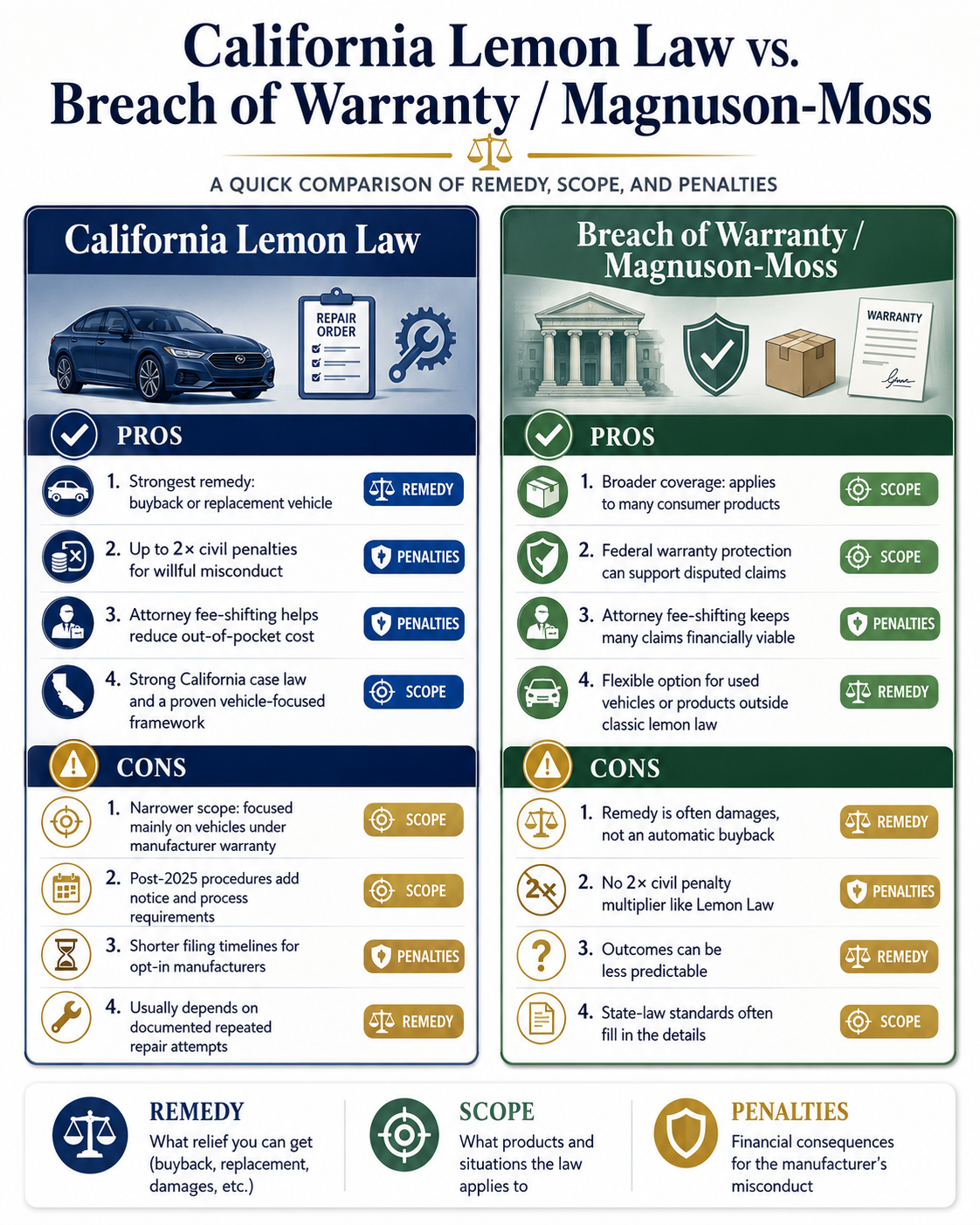
- Strongest remedy available — a buyback or a new replacement vehicle, not just damages.
- Up to 2× civil penalties for manufacturers that act in bad faith, which raises settlement value.
- Fee-shifting means qualified San Diego drivers typically pay nothing out of pocket.
- Well-developed CA case law gives experienced attorneys a clear, proven playbook.
Cons of the California Lemon Law
- Narrower scope — built around vehicles with active manufacturer warranties.
- Stricter procedures since 2025 — AB 1755/SB 26 added notice steps and shorter deadlines for opt-in manufacturers.
- Repair-history dependent — you generally need documented, repeated failed repair attempts.
Pros of Breach of Warranty (Magnuson-Moss)
- Broad coverage — applies to virtually any consumer product, not just cars.
- Federal backstop — strengthens a case when a manufacturer disputes state-law coverage.
- Fee-shifting mirrors the Lemon Law’s, keeping it affordable.
- Flexible — works for used vehicles and products the state law may not squarely reach.
Cons of Breach of Warranty (Magnuson-Moss)
- Weaker default remedy — typically damages rather than an automatic buyback.
- No statutory penalty multiplier comparable to Song-Beverly’s 2× provision.
- Relies on state law to fill in standards, which can make outcomes less predictable.

Which Option Is Better? (The Ultimate Showdown)
Here’s where the false binary breaks down. Because both routes shift attorney’s fees onto the manufacturer, the real question usually isn’t “which one is cheaper for me?” — it’s “which one delivers the better outcome for my specific situation?”
Choose the Lemon Law as your lead claim if you bought or leased a vehicle in California, it’s still under the manufacturer’s warranty, and it has a documented, repeating defect. The buyback-or-replacement remedy plus potential 2× civil penalties simply outguns a standard damages award. For the typical San Diego household that depends on a single reliable commuter car for the daily grind up I-805 or the haul out to East County, getting the defective vehicle off your hands entirely — not just a check for lost value — is almost always the goal.
Lean on a breach of warranty claim if the Lemon Law’s edges don’t fit: the warranty status is murky, it’s a used vehicle with contested coverage, or the defective product isn’t a vehicle at all. Magnuson-Moss casts a wider net and gives you a federal foothold.
The strongest strategy for most cases is “both.” Skilled attorneys routinely plead Song-Beverly and Magnuson-Moss (often alongside express and implied warranty theories) in the same complaint filed in San Diego County. The state claim chases the maximum remedy; the federal claim guards your flank if the manufacturer attacks the state claim’s coverage. You don’t have to gamble on one — you can run them in parallel.
Talk to a San Diego Lemon Law Attorney
You don’t need to decode AB 1755 or weigh Song-Beverly against Magnuson-Moss on your own — that’s our job. If you’re a San Diego resident driving a vehicle that’s spent more time in the service bay than in your driveway, a quick case review will tell you which path (or combination) gives you the strongest claim, and what it could be worth. Because California’s warranty laws shift attorney’s fees onto the manufacturer, qualified drivers typically pay nothing out of pocket.
Conclusion & Recommendation
For the vast majority of San Diego drivers with a genuinely defective vehicle still under warranty, the California Lemon Law is the stronger primary claim — its buyback/replacement remedy and 2× civil-penalty potential are simply more powerful than a typical breach of warranty award. Breach of warranty under Magnuson-Moss earns its place as the broader, supplemental claim, covering situations the state law doesn’t squarely reach and backstopping your case in federal terms. The smartest move is rarely to pick just one — it’s to have an experienced San Diego attorney evaluate both and pursue whichever combination maximizes your result.
This page provides general information and is not legal advice. Outcomes depend on your specific facts; consult a licensed California attorney about your situation.
Frequently Asked Questions
1. Is the Lemon Law the same as a breach of warranty claim?
Not exactly. A Lemon Law claim is a type of breach of warranty claim, but it’s a specialized, vehicle-focused one under California’s Song-Beverly Act with stronger remedies (buyback or replacement). “Breach of warranty” is the broader umbrella, most often pursued federally under the Magnuson-Moss Warranty Act.
2. Can I file both a Lemon Law and a breach of warranty claim at the same time?
Yes. San Diego attorneys frequently plead the state Song-Beverly claim and the federal Magnuson-Moss claim together, so the federal claim acts as a backstop if the manufacturer disputes state-law coverage.
3. Which claim gives me a bigger payout?
The Lemon Law usually offers the stronger remedy because it can force a full buyback or replacement and allows civil penalties up to twice your damages for willful violations, while breach of warranty claims typically recover money damages.
4. Does it cost money to pursue these claims in San Diego?
Usually not out of pocket. Both California’s Lemon Law and the Magnuson-Moss Act require a losing manufacturer to pay the prevailing consumer’s attorney’s fees, so most attorneys work on contingency.
5. How did the 2025 changes (AB 1755 and SB 26) affect my rights?
Your right to a buyback or replacement is unchanged. What changed is the procedure for manufacturers that opted into the new framework — including pre-litigation notice and shorter deadlines — which makes acting promptly more important.
6. Does the Lemon Law cover used or leased vehicles in California?
It can. Many used vehicles still under a manufacturer’s warranty qualify, and leased vehicles are covered too. Coverage details vary, so a case review is the best way to confirm.
7. What if my defective product isn’t a car?
Then a breach of warranty claim under Magnuson-Moss is likely your route, since it covers virtually all consumer products with a written or implied warranty — not just vehicles.
8. How long do I have to file a claim in San Diego?
Breach of warranty claims generally follow California’s four-year limitations period, and Lemon Law deadlines are broadly similar — but tighter for AB 1755 opt-in manufacturers. Because deadlines have shortened, it’s wise to get your case reviewed early.
Lawyer Associations


Scott Law Group P.C. May be Able to Help
At our top rated firm, we have over a decade of prior law experience defending Fortune 500 companies in these types of complex cases. Every case is unique and we fight arduously to find a solution to every case and have the courts decide in our clients’ favor. We use our extensive professional experience to find the best positive outcome possible for our valued clients. Some lemon law firms will hand over the case to another law firm if the manufacturer wants to go to trial. But Christian is aggressive and willing to litigate in order to get a favorable result for his valued clients. Whether you bought or leased a new or used motor vehicle such as a car, truck, motorcycle, SUV or RVs/motor home, let us give you our expert advise. You may have numerous frequently asked questions prior to deciding to pursue a case. Rather than have you try to figure it out for yourself, let us advise you and let’s talk it through. We’ll address any concern and answer any question you may have prior to making any decisions on pursuing a case. We provide statewide service in California.
Rather than try to take on the vehicle manufacturer yourself, call the best lemon law lawyer in San Diego and let Christian Scott, the best attorney in your area give you the professional advice you need regarding a possible case. We provide statewide service and we offer the best customer service around. Do not hesitate any longer, call now for a FREE case review. All calls are returned within 24 hours. Or if you prefer, complete the FREE Case Review Form. Remember, you have nothing to lose, it’s FREE!
Litigation Lemon Law Group
SCOTT LAW GROUP P.C. represents plaintiffs detailed in the areas served section and across California who have purchased a lemon vehicle, have been seriously injured in an accident or have been a victim of dealer fraud. Examples of dealer fraud include undisclosed repairs or accident damage, undisclosed rental use and changing the terms after the purchase has been negotiated and the car is taken home. If you received a Notice of Intent after your vehicle was repossessed or if you purchased a prior lemon vehicle, we want to hear from you. We have also provided a lemon law news section where you can reference information regarding this issue. We have over a decade of prior experience defending Fortune 500 companies in these types of cases. We know what corporate America thinks, does and hides and we use that experience to sue auto manufacturers, dealerships, businesses and individuals on behalf of our valued clients to recover damages and rightly compensate them for their losses. We provide excellent legal representation in both English and Spanish (Español). We can evaluate your case via our online Free Case Review form. We are serious. We achieve amazing results for our valued clients. This is who we are. This is what we do and we do it well.
